Harris County
AC repair and HVAC service in southwest Houston
Seventy-year-old neighbourhoods where the equipment has been replaced three times and the duct system has not been touched since Eisenhower was president.
Local context
Houston’s first suburbs, now seventy years old
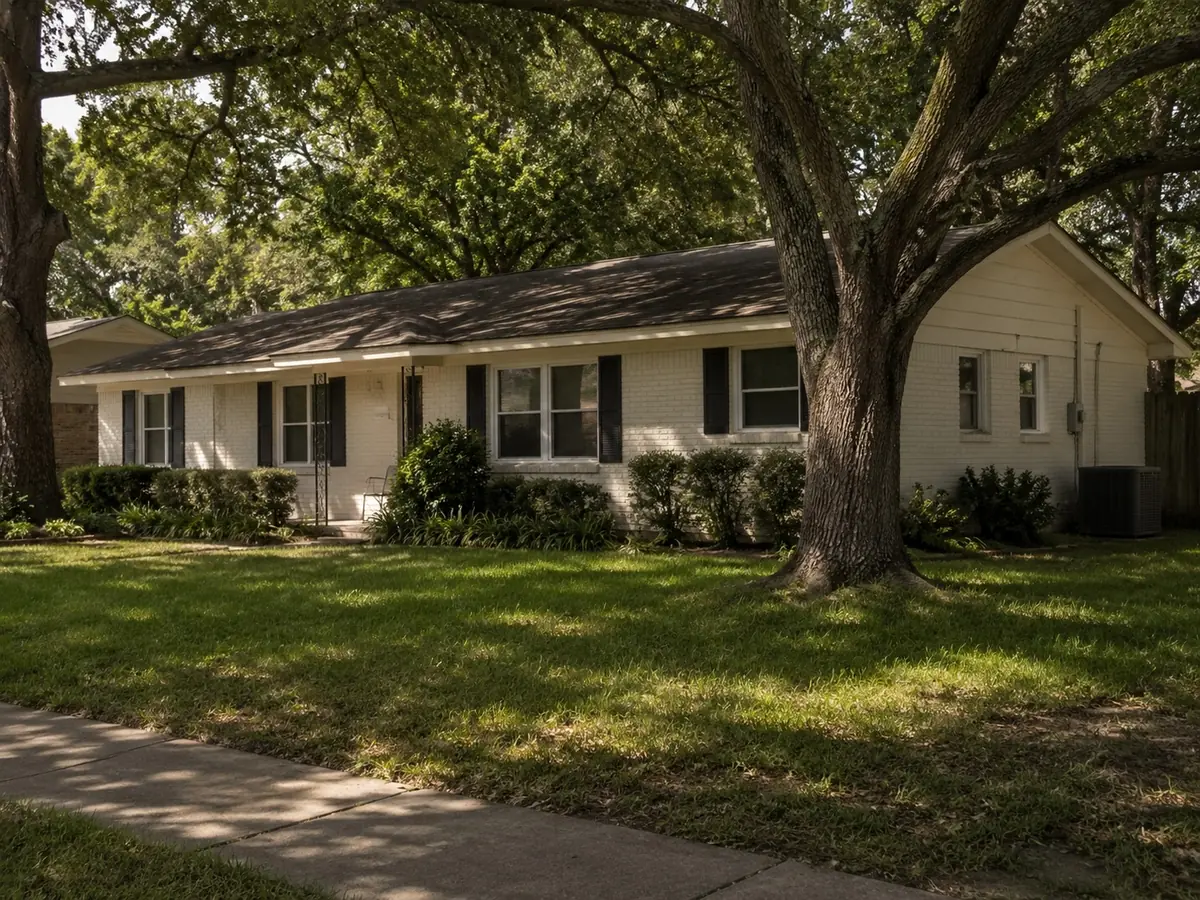
This part of the city was built in a concentrated burst in the mid-1950s, and the housing stock reflects it almost uniformly.
Sharpstown was dedicated on 13 March 1955, developed by Frank Sharp as one of the first master-planned, automobile-centred communities in Houston, with provision made for schools, shopping and recreation alongside the housing. Sharp donated a 300 foot wide strip of land through the development to the state for construction of the Southwest Freeway, which is why Interstate 69 runs where it does.
Meyerland was developed the same year, when George Meyer laid out roughly 1,200 acres, with Vice President Richard Nixon attending the ribbon-cutting. It was one of the first deed-restricted communities in the City of Houston, and its housing is characteristically mid-century: ranch houses from the fifties and sixties in Tudor, colonial and contemporary variations. It sits outside the 610 Loop, inside Beltway 8, immediately south of Bellaire.
Westbury, Braeswood, Braeburn and the Fondren area follow the same broad pattern and the same broad era.
Seventy years is a long time for a house, and it is several lifetimes for a duct system.
Southwest Houston at a glance
- County: Harris
- Core era: mid-1950s onward
- Dominant housing: single-storey mid-century ranch
- Neighbourhoods: Sharpstown, Westbury, Meyerland, Braeswood, Braeburn, Fondren
- Permitting: City of Houston, not a suburban city department
- From our office: a short run north up I-69
The defining issue
Modern equipment on a 1955 distribution system
Almost every difficult HVAC problem in these neighbourhoods traces back to the same root. The equipment has kept pace with the decades. Everything between the equipment and the rooms has not.
A typical Westbury or Sharpstown house has had three or four air conditioners since it was built. Each was fitted to the ductwork that was already there, because that is the quick and cheap way to do a changeout. Over seventy years, that produces some recognisable situations.
Returns sized for 1955 equipment. A single central return grille, sized for a system considerably smaller and less demanding than what is fitted now. The blower fights that restriction on every cycle, static pressure runs high, and airflow across the whole house suffers.
Duct that has been extended rather than designed. Rooms added, garages converted, kitchens opened up, with duct branches spliced in as each project happened. The result is a system nobody designed, assembled over decades by different people.
Original materials still in place. In some houses, sections of duct genuinely predate every occupant currently on the street.
Equipment in tight or awkward locations. Mid-century houses often put the air handler in a hall closet or a small attic space with limited working room and limited return path.
The practical implication is the same one every time. In these neighbourhoods, testing the duct and measuring static pressure before replacing equipment is not an upsell, it is the only way to avoid installing a fourth system that performs like the previous three. See ductwork.
Worth knowing
Flooding history and mechanical systems
Parts of Meyerland lie within the 100-year floodplain, and the area saw significant flooding during Hurricane Harvey in 2017 and the Memorial Day flooding of 2015 from Brays Bayou. Since Harvey, considerable rebuilding has taken place, with newer homes constructed several feet above the minimum base flood elevation.
For HVAC work that history matters in a few practical ways. Houses that have been elevated or substantially rebuilt often have relocated mechanical systems and newer duct, which is generally good news. Houses that were flooded and repaired rather than rebuilt may have equipment and duct with a water history that is worth establishing before a diagnosis, since it affects corrosion, insulation condition and what is realistic to salvage.
It is also a reason to take condensate and drainage seriously in this area specifically. A household that has already dealt with water damage once has no appetite for a repeat caused by a blocked drain line.
Worth knowing before you call
- Your neighbourhood and roughly when the house was built
- Whether the ductwork has ever been replaced, if you know
- Whether the property has a flood history
- Where the indoor equipment is: attic, closet or garage
- What the system is doing now
24/7 emergency HVAC service. Office monday - saturday, 9:00am - 6:00pm.
The neighbourhoods
Southwest Houston inside Beltway 8
Sharpstown, Westbury, Meyerland, Braeswood and Fondren, with Bellaire to the northeast. Positions are approximate.
Services here
HVAC work we do in southwest Houston
AC repair
Diagnosis and repair when a system stops cooling or stops running.
AC replacement
Sizing, equipment, permits and installation when repair stops adding up.
Emergency service
Round-the-clock cover for a total cooling failure.
Ductwork
Leak repair, sealing, resizing and replacement.
Zoning and airflow
Balancing, dampers and zoning for houses one thermostat cannot serve.
Maintenance
Coil, drain and electrical service before the season loads the system up.
Nearby areas and related pages
Stafford
Where the office is, south down I-69.
Sugar Land
Southwest, with a very different housing profile.
Missouri City
South, where the mid-century pattern continues in places.
Ductwork
The single most relevant service in these neighbourhoods.
Hot and cold spots
What decades of spliced-in duct branches produce.
AC replacement
Why testing the duct first matters more here than anywhere.
Southwest Houston questions
Which southwest Houston neighbourhoods do you cover?
My house is from the fifties. Is the ductwork original?
Does flooding history affect HVAC equipment?
Do Houston permitting rules differ from Sugar Land or Stafford?
In a fifties house, the age of the ductwork is usually the most useful thing you can tell a technician.
Call (866) 427-9264Fifties house, modern system, still uncomfortable?
That combination has a well-understood cause in these neighbourhoods, and it is not usually the equipment.