Component
Evaporator coil replacement
The indoor coil is where a lot of expensive HVAC conversations start. Here is what it does, why it fails, and how to think about the decision it forces.
What the coil does
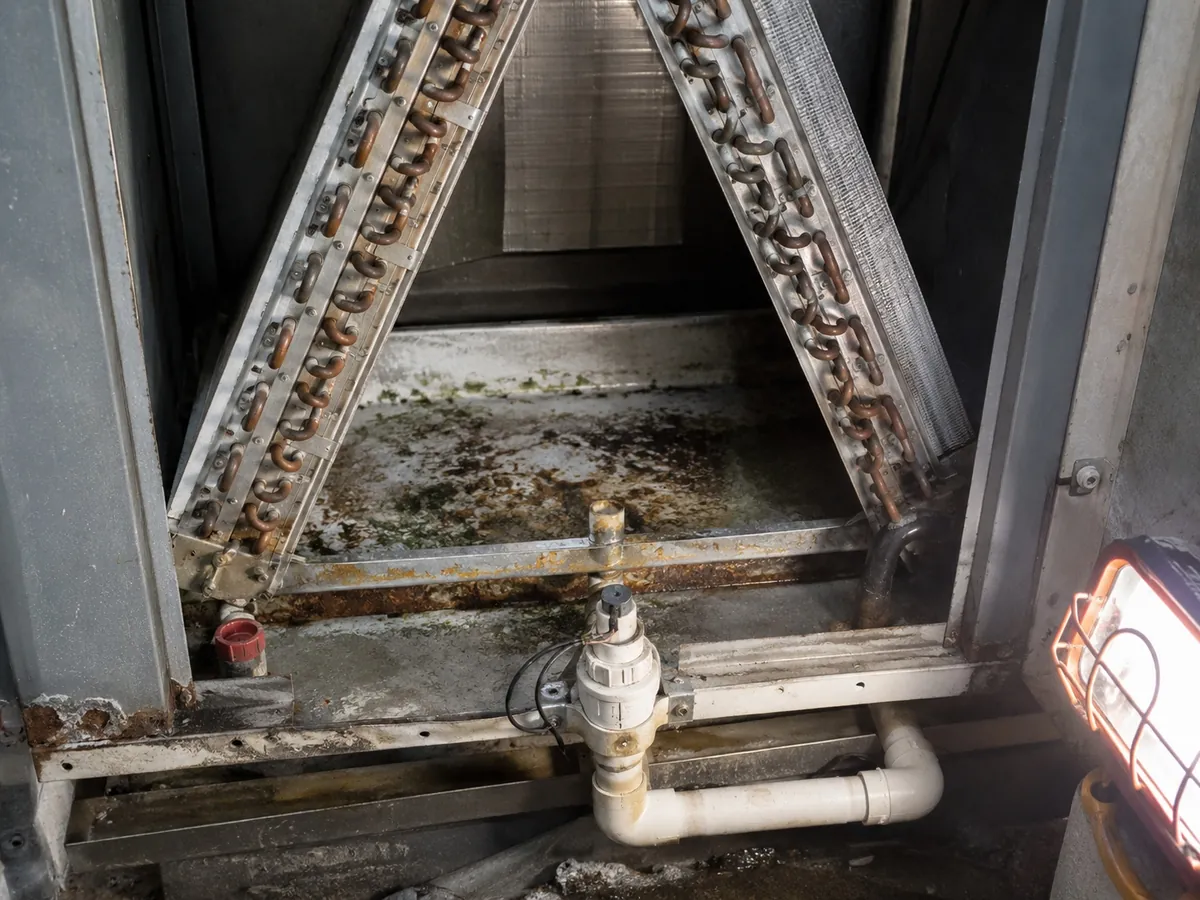
The evaporator coil is the indoor half of the refrigeration circuit, usually sitting above or inside the air handler. Refrigerant enters it as a cold low-pressure liquid, the blower pushes household air across it, the refrigerant absorbs heat from that air and boils into a vapour, and the cooled air goes back into the house.
It is also where dehumidification happens. Moisture condenses on the cold coil surface, drips into the drain pan, and leaves through the condensate line, which is why the coil and the drain are so closely connected in practice.
When a coil leaks, the system loses charge and cooling capacity falls. When it is dirty or iced, airflow drops and the same thing happens for a different reason.
Signs pointing at the coil
- Repeated low refrigerant charge with no leak found elsewhere
- Cooling that weakens over a season and returns briefly after a recharge
- Ice forming on the indoor coil or the line near it
- A hissing sound from the indoor unit
- Water in the drain pan beyond what the drain can handle
- A system that has already been recharged more than once
None of these confirm a coil leak on their own. Confirming it is a leak-detection job.
Call (866) 427-9264Why coils fail
Corrosion, not wear
Evaporator coils rarely fail mechanically. They fail through corrosion of thin-walled copper tubing, and the mechanism is worth understanding because it explains why patching usually disappoints.
Formicary corrosion is the common culprit. Certain organic compounds present in ordinary indoor air, from cleaning products, adhesives, new building materials and general household sources, react with copper in the presence of moisture and oxygen. The result is a network of microscopic tunnels through the tube wall, hence the name. It produces pinhole leaks rather than a single failure point, and it produces them across the coil rather than in one place.
That is why a repaired coil so often leaks again somewhere else within a season. The corrosion is not localised.
A permanently damp coil in a humid climate provides the moisture side of that reaction continuously through cooling season, which does not help. Neither does a coil left dirty, since accumulated debris holds moisture against the surface.
Physical damage is the other cause: fins crushed during a previous service, damage from cleaning with the wrong tools, or vibration wear where tubing contacts the cabinet.
The decision
Coil, or whole system?
This is the real question a coil failure forces, and the honest answer depends on four things rather than on a rule of thumb.
Age of the system. Under about eight years, replacing the coil is usually sensible. Past twelve to fifteen, you are investing a significant fraction of a replacement into equipment whose remaining life is limited.
Warranty status. A coil covered under a manufacturer parts warranty changes the arithmetic considerably, because the largest single cost disappears and you are left paying for labour and materials.
Matching. The indoor coil and outdoor condenser are rated as a matched pair. A replacement coil that is not properly matched gives up efficiency and can affect warranty coverage on the rest of the system.
Refrigerant. On an R-410A system, a coil replacement keeps you on a refrigerant whose price is rising as the EPA phase-down tightens supply. That is not a reason on its own, but it belongs in the calculation.
What should not decide it is pressure. Anyone who cannot give you both numbers and let you think about it overnight is selling rather than advising.
Typical cost range
2026 national data puts evaporator coil replacement broadly in the $1,900 to $3,000 region, lower where the part is under warranty and higher on larger systems or awkward attic installations.
Compare that against replacement ranges before deciding. The calculator shows both.
Ranges come from published Houston-area and national pricing data. Sources and assumptions are listed on the calculator page.
Call (866) 427-9264The work
What replacement involves
Recover the refrigerant
The existing charge is recovered properly rather than vented, which is both a legal requirement and part of doing the job correctly.
Remove the old coil
Opening the cabinet or plenum, disconnecting the line set and drain, and getting the old coil out. In an attic this is the part that takes the time.
Fit the matched replacement
A coil correctly matched to the outdoor unit, with a new metering device where the coil comes with one, and a new filter drier fitted as standard.
Braze, pressure test and evacuate
Connections brazed under nitrogen, the system pressure tested to confirm it holds, then evacuated to remove moisture and non-condensables before charging.
Charge by weight and verify
Charged to manufacturer specification rather than by feel, then superheat, subcooling and temperature split checked to confirm the system performs correctly.
Sort the drain while it is open
New drain connections, a clean pan and a working float switch. The cabinet is already open, and this is the cheapest it will ever be to do.
Related pages
Refrigerant leak repair
How a coil leak gets confirmed in the first place.
Frozen AC coil
Icing, which is a different coil problem with different causes.
AC replacement
The alternative that a coil failure often triggers.
Clogged drain line
The drain work that should happen alongside a coil job.
AC not cooling
The symptom that usually starts this.
Cost calculator
Coil replacement against full system replacement.
Evaporator coil questions
How much does evaporator coil replacement cost?
Can a leaking coil be repaired instead of replaced?
My coil is under warranty. Does that make it cheap?
Should I replace the whole system instead?
Been told you need a coil? A second opinion on coil versus system is a reasonable thing to want.
Call (866) 427-9264Not sure whether the coil or the system should be replaced?
Age, warranty status, matching and refrigerant type all feed into that. Worth getting both numbers before committing to either.