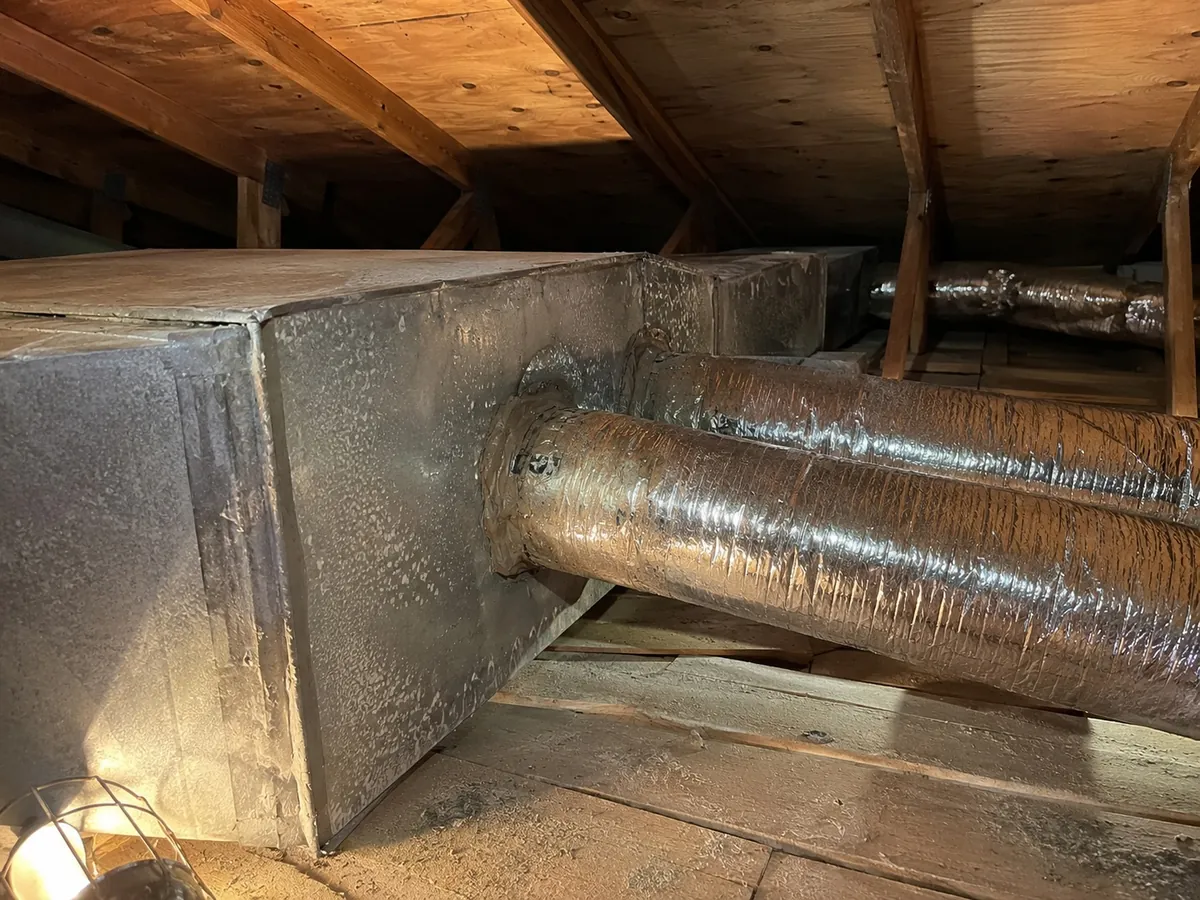
Air distribution
Ductwork repair, sealing and replacement
A correctly sized, correctly charged system attached to bad ductwork will still leave rooms uncomfortable. In older houses the duct is often the actual problem.
The core problem
Leaky attic duct is worse here than almost anywhere
Most houses in this part of Fort Bend County and southwest Houston run their supply and return ducts through the attic. On a summer afternoon that attic is dramatically hotter than the outdoor air, and considerably hotter than the 55°F air moving through the duct.
Two things happen when that duct leaks. Air you have already paid to cool escapes into the attic and never reaches a room. And on the return side, the system pulls superheated attic air into the return, so the air handler is trying to cool air that arrives hotter than the air in the house. The second is worse than the first, and it is common in older return configurations.
The visible result is a house that cannot hold setpoint on hot afternoons, a system that runs almost continuously, and rooms at the ends of long duct runs that are simply never comfortable. Homeowners usually assume the equipment is undersized. Frequently it is not.
The other consequence is humidity. A system pulling in unconditioned attic air is also pulling in that air’s moisture. In a metro averaging around 75% relative humidity, that shows up as a house that feels sticky even when the thermostat reads 74°F.
Worth knowing before you call
- Which rooms are uncomfortable, and whether it is worse upstairs
- Whether the problem is year round or only on very hot days
- Roughly when the house was built, and whether ductwork has ever been replaced
- Whether you have noticed dust returning quickly after cleaning
24/7 emergency HVAC service. Office monday - saturday, 9:00am - 6:00pm.
What the work involves
Duct services
Leak testing and diagnosis
Measuring rather than guessing. Static pressure readings, airflow at the registers and a look at how the system was actually put together.
Sealing
Mastic and mechanical fastening at plenums, boots, branch takeoffs and joints, which is where the majority of leakage lives.
Resizing and redesign
Correcting trunk and branch sizes, adding return capacity, and fixing runs that were too long or too restricted from the start.
Replacement
New duct where the existing material is deteriorated, crushed, disconnected or so undersized that sealing it achieves nothing.
Rerouting for construction
Moving runs so a ceiling can be raised, a wall removed or a room added. This is where the construction side of the business does the heavy lifting.
Return air correction
Undersized returns are the single most common design fault in older houses here, and one of the most rewarding to fix.
The part nobody looks at
Return air is usually the real bottleneck
Almost every conversation about airflow focuses on the supply side, on which vents blow and how hard. The return side gets ignored, and it is where a large share of comfort problems actually originate.
A system can only push out as much air as it can pull in. If the return path is undersized, and in a great many houses built before returns were taken seriously it is, the blower is fighting a restriction on every cycle. That produces low airflow across the whole house, a coil running colder than it should, higher static pressure, more strain on the blower motor, and a persistent tendency toward frozen coils.
Two patterns show up repeatedly in this area. The first is a single central return sized for a much smaller system, usually because the equipment was upgraded at some point and the return never was. The second is bedrooms with supply vents but no return path at all, where closing the door effectively seals the room off. The room then pressurises, airflow into it drops, and it becomes the room that is always warm.
Both are fixable, and neither requires new equipment. Adding return capacity or cutting properly sized transfer paths often does more for comfort than anything that can be bought at the condenser.
Local housing stock
What we find in different neighbourhoods
Mid-century southwest Houston
Sharpstown was dedicated in 1955 and Meyerland was developed from 1955 onward, so the housing stock in that band of the city is now seventy years old. Duct systems there have frequently been replaced once, sometimes badly, and returns were sized for equipment that has since been upgraded twice.
Late-seventies to nineties Fort Bend
First Colony began in 1977 and Greatwood and New Territory came at the end of the eighties. Two-storey houses with attic air handlers dominate, and the usual finding is long flexible runs to upstairs rooms with sharp bends and sag between supports.
Newer master-planned areas
Telfair, Riverstone and Sienna are far newer and the duct is generally in better condition. Problems there tend to be design rather than deterioration: a room over a garage, a bonus room, or a two-storey volume that one thermostat cannot balance.
Related pages
Zoning and airflow
When duct is sound but the house still cannot balance.
Upstairs not cooling
The commonest symptom of a duct and return problem in two-storey houses.
Hot and cold spots
Room-by-room temperature differences and what causes them.
AC replacement
The natural moment to correct duct problems rather than inherit them.
Frozen AC coil
Restricted airflow is one of the two main causes.
HVAC for remodels
Rerouting duct when the house itself changes shape.
Ductwork questions
How do I know if my ducts are leaking?
Is it better to seal ducts or replace them?
What does duct replacement cost?
Do I need my ducts cleaned?
If particular rooms have never been comfortable, describing which ones and when narrows this down quickly.
Call (866) 427-9264Rooms that never cool, whatever the thermostat says
That pattern usually points at distribution rather than equipment. Worth a conversation before anyone talks about a new system.