Component
AC capacitor replacement
One of the most common failures on a residential system, and one of the least expensive to put right. It is also the reason a lot of outdoor units hum without starting.
What a capacitor does
Compressors and fan motors need a strong electrical push to start, and a smaller sustained push to keep running efficiently. The capacitor provides that. In most residential systems a single dual-run capacitor serves both the compressor and the condenser fan, with separate terminals for each.
Capacitors degrade with heat and with the number of times they are called on. When capacitance drops below what the motor needs, the motor struggles to start, draws excessive current, and eventually will not start at all.
The signature symptom is an outdoor unit that hums but does not turn, or a condenser fan that spins normally while the compressor does nothing.
Signs pointing this way
- A hum from the outdoor unit with nothing turning
- The outdoor fan spinning while the air indoors stays warm
- The system starting on some attempts and not others
- A clicking sound as the unit repeatedly tries to start
- Cooling that has become progressively weaker over weeks
- The outdoor fan blade turning easily by hand but not starting under power
A bulging or leaking capacitor top is a definite fail, but plenty of failed capacitors look perfectly normal.
Call (866) 427-9264Why here
Heat and runtime are what kill them
Capacitors are rated for a temperature range and a service life that assume a certain amount of use. Houston gives them considerably more of both than the rating assumes.
The cooling season runs roughly April through October, so the system cycles for the better part of seven months. The outdoor unit sits in direct sun, and the electrical compartment inside it runs hotter than ambient. Every start puts the capacitor under load, and a system cycling several times an hour on a hot day accumulates starts quickly.
Add anything that makes the compressor work harder, such as a dirty condenser coil raising head pressure, and the capacitor degrades faster still. That is why a good technician cleans and checks the coil before deciding the job is done.
The practical implication is worth knowing: capacitor values drift before they fail outright. A capacitor measuring meaningfully below its rating is a component on its way out, and replacing it during a scheduled maintenance visit in April costs the same part and avoids a Sunday afternoon without cooling in August.
What it typically costs
Published 2026 data places professional capacitor replacement in the region of $150 to $450, covering the part, labour and the diagnostic charge. Flat-rate pricing at some companies runs higher.
The part is genuinely inexpensive. The value in the visit is confirming the capacitor is actually the fault rather than a symptom of something else.
Ranges come from published Houston-area and national pricing data. Sources and assumptions are listed on the calculator page.
Call (866) 427-9264The repair
What a proper capacitor job includes
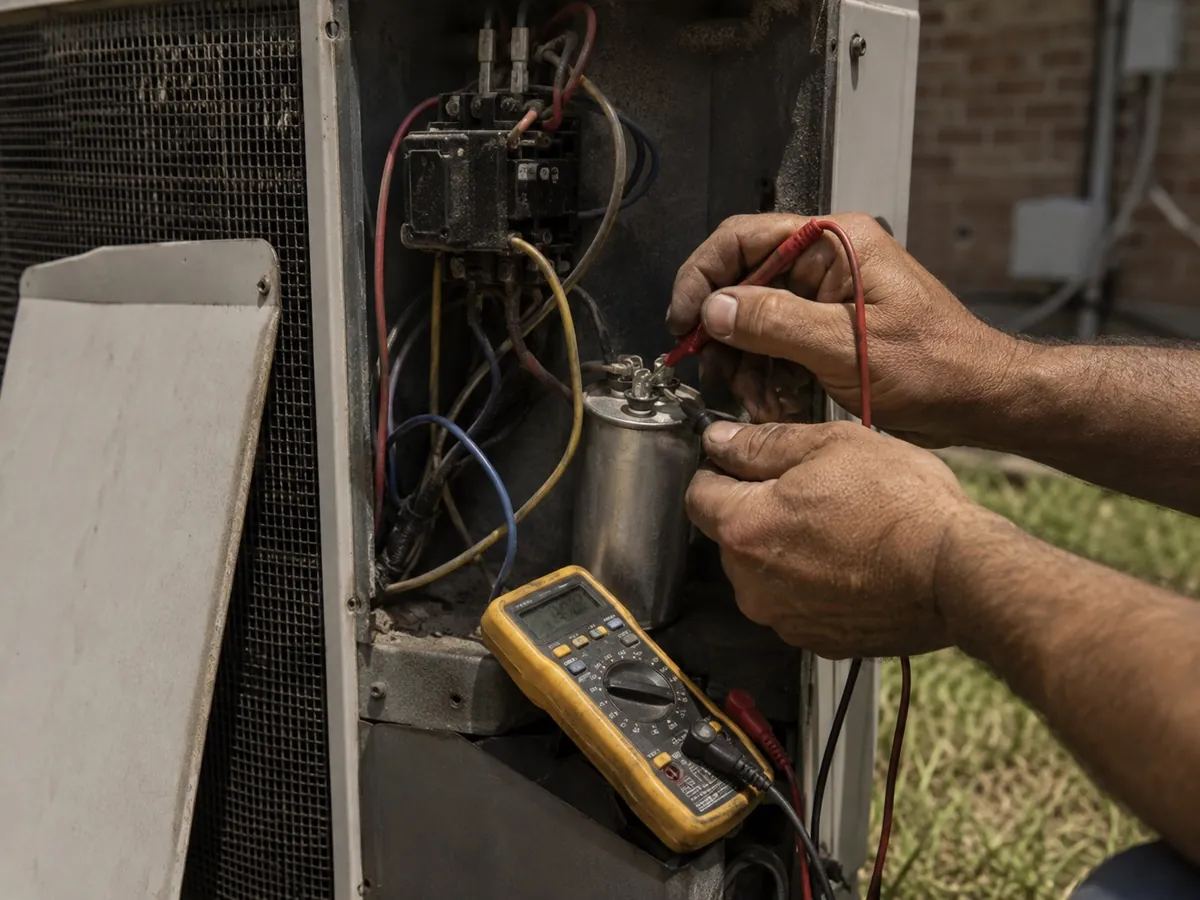
It starts with a measurement. Capacitance is read against the rating stamped on the case, because a capacitor can look perfectly healthy and be well out of tolerance. Appearance is not a diagnosis.
The old unit then has to be discharged safely before it is touched, which is the step that makes this a job for somebody carrying the right tools. The replacement needs the correct microfarad values for both the compressor and fan sections, and a voltage rating at or above the original.
Then comes the part that gets skipped. Compressor amp draw, contactor condition and condenser coil cleanliness all get checked, because a capacitor that failed from a straining compressor will fail again. Finally, start and run readings after replacement, plus a temperature split across the coil to confirm the house is actually being cooled rather than the outdoor unit merely spinning.
If a technician fits a capacitor and leaves within ten minutes having checked nothing else, you have had a part replaced. That is not the same as having a system diagnosed.
Worth knowing before you call
- Whether the outdoor unit hums, clicks or is silent
- Whether the outdoor fan blade is turning
- Whether cooling has been getting gradually weaker
- Roughly how old the system is
- Whether a breaker has tripped
24/7 emergency HVAC service. Office monday - saturday, 9:00am - 6:00pm.
Leave this part to a technician
A capacitor stores a charge after power is disconnected, and it holds enough energy to injure someone. It has to be discharged properly before it is touched.
Fitting the wrong capacitance or voltage rating damages the motor it serves, which turns an inexpensive repair into an expensive one.
This is not a case where the trade is protecting its work. It is a genuinely small bill for a job with a real hazard attached.
Related pages
AC blowing warm air
The most common symptom a failed capacitor produces.
AC not turning on
When the failure is complete rather than partial.
Compressor replacement
What a neglected capacitor problem can eventually cause.
HVAC maintenance
Where a drifting capacitor gets caught before it strands you.
AC repair
The wider diagnostic visit.
Cost calculator
Ranges for this and other common repairs.
Capacitor questions
What does capacitor replacement cost?
Can I replace a capacitor myself?
How long should a capacitor last?
If the capacitor failed, is something else wrong?
A humming outdoor unit that will not start is usually this, and usually fixed on the visit.
Call (866) 427-9264Outdoor unit humming but going nowhere?
This is one of the more likely explanations and one of the cheaper ones. Worth confirming rather than assuming the worst.