Air conditioning repair
AC repair for Stafford, Sugar Land and southwest Houston
If the house is getting warmer and the system is not keeping up, the useful next step is a diagnosis rather than a guess. Call and describe what it is doing.
Start with the symptom
What is the system actually doing?
Air conditioning failures fall into a small number of patterns, and the pattern usually narrows the cause down to two or three possibilities before anyone opens a panel. It is worth knowing which one you are looking at.
A system that runs constantly without cooling normally points at airflow, refrigerant charge or a compressor that is not doing useful work. A system that will not start at all points at power, controls or a safety device that has done its job. A system that starts and stops every few minutes points at short cycling, which has its own set of causes. And water where water should not be is nearly always the condensate drain.
Pick whichever of these is closest and the linked page will take you through it in detail.
Worth knowing before you call
- Brand and rough age, from the label on the outdoor unit
- What the thermostat is set to and what it currently reads
- Whether the outdoor fan is spinning, humming or silent
- Whether the problem started suddenly or got worse over weeks
- Any breaker that has tripped, and whether it tripped again
24/7 emergency HVAC service. Office monday - saturday, 9:00am - 6:00pm.
Common symptoms
Each page covers likely causes, what is safe to check yourself, and the point where guessing gets expensive.
What tends to fail
The parts that break most often in this climate
Houston averages about 102 days a year at or above 90°F, and cooling season runs roughly April through October. A residential system here accumulates far more operating hours than the same equipment installed in a milder climate, and the failure pattern reflects that. Wear parts go first.
Capacitors and contactors
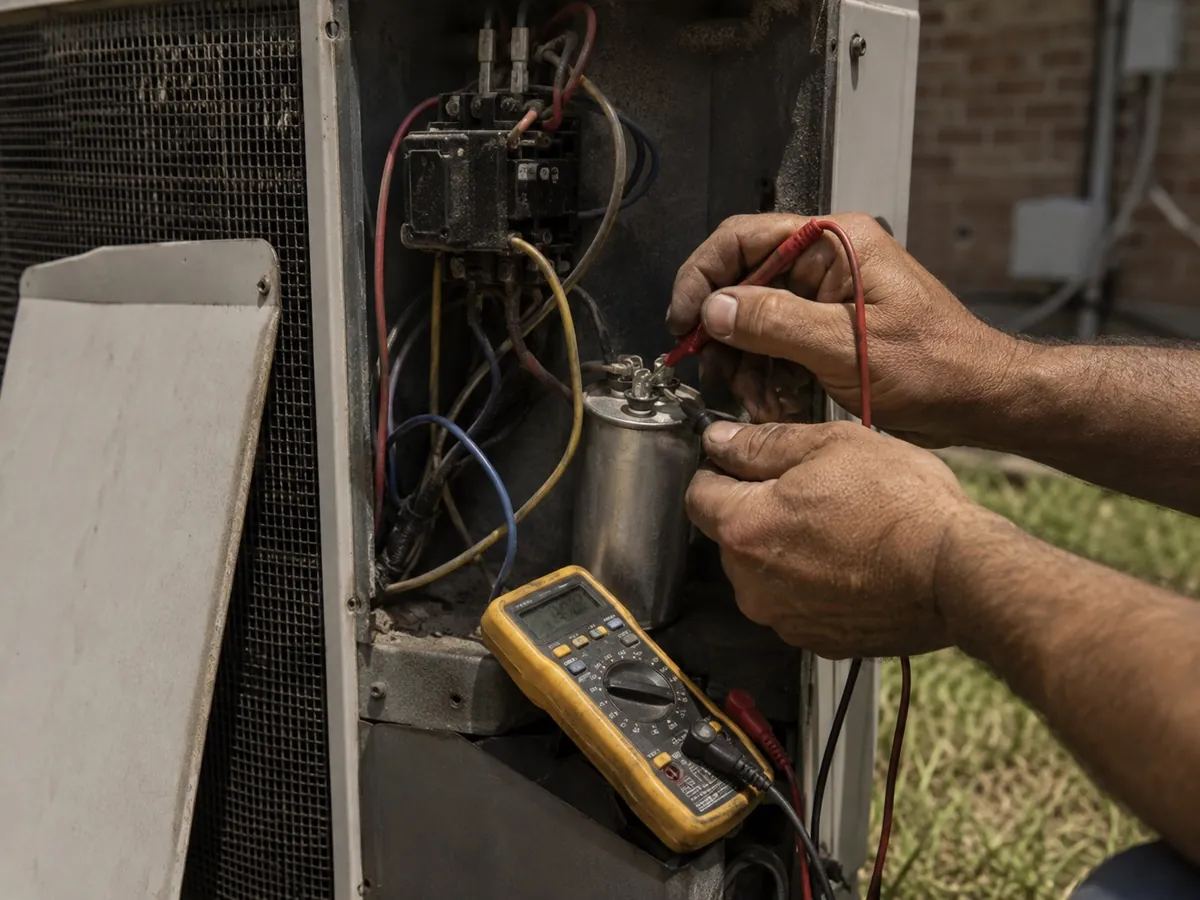
The run capacitor gives the compressor and condenser fan the electrical push they need to start, and it degrades with heat and cycles. A weak one produces a system that hums but will not start, or one that starts on some attempts and not others. The contactor is the relay that switches the outdoor unit on, and its contacts pit and burn over time. Both are among the least expensive repairs on a system and among the most common. More on capacitor replacement.
Condensate drains and float switches
An evaporator coil in a humid climate pulls a substantial volume of water out of the air every day. It leaves through a drain line that, in most houses here, runs across an attic. Biological growth restricts that line, water backs up, and a float switch shuts the system down to stop it flooding a ceiling. When people say the AC “just stopped for no reason” on a hot afternoon, a tripped float switch is one of the first things to check. See clogged drain lines and float switches.
Blower motors
The indoor blower runs whenever the system calls for cooling, which in July is close to continuously. Motors that have pushed air through a dirty filter or an undersized return for years fail earlier than they should. Symptoms range from weak airflow to a system that cools normally for twenty minutes then stops moving air. More on blower motors.
Refrigerant leaks
Refrigerant is not consumed. A system that is low on charge has a leak, usually at a coil, a fitting or a section of line set. Low charge produces poor cooling, long run times, and often a frozen evaporator coil. This is where the repair-or-replace conversation usually starts, because leaks in an evaporator coil are expensive to fix and R-410A itself has become costly since the EPA began phasing it down. More on refrigerant leaks.
Compressors
The compressor is the most expensive component in the system. It rarely fails first. It usually fails because something else went unaddressed: a persistent low charge, a failing capacitor that made it work hard on every start, or airflow that was restricted for years. When a compressor goes on a system past ten years old, replacement is normally the more sensible route. More on compressors.
Component pages
Useful if a technician has already named the part and you want to understand what you are being quoted for.
What happens on the visit
How the diagnosis actually works
Reasonable people are suspicious of contractors, and they should be. Here is what the process looks like so nothing is a surprise.
The conversation before anyone drives out
What the system is doing, how long it has been doing it, and whether it is a total failure or a comfort complaint. Some problems can be narrowed down considerably over the phone, and occasionally something can be resolved without a visit at all.
Thermostat and airflow first
Settings, calls for cooling, filter condition, return air and supply temperatures. A surprising share of no-cooling calls are resolved here, and starting anywhere else risks replacing a part that was never the problem.
Electrical checks at the equipment
Voltage, capacitor values, contactor condition, motor draw and safety switches. This is where the most common failures are found, and it is also the reason this work belongs to somebody with proper test equipment.
Refrigerant and coil condition
Pressures, superheat and subcooling, coil cleanliness and drain condition. These readings tell you whether the charge is correct, whether the system is restricted and whether there is a leak worth chasing.
What it is, what it costs, what happens if you wait
You get the finding, the price for the repair, and an honest read on urgency. If the sensible answer is that the system is near the end of its life, you get that too, with the replacement numbers alongside so you can compare.
The decision behind the repair
When repair stops being the right answer
There is no single rule, but three things settle it most of the time.
Age. Residential cooling equipment in this climate works hard. A system in its mid-teens has less remaining life than the same system would have further north, simply because of accumulated runtime.
What the failure is. A capacitor on a twelve year old system is worth fixing. A compressor or a leaking evaporator coil on the same system usually is not, because you are spending a significant fraction of a replacement on equipment that will need replacing soon anyway.
What you have already spent. Two or three repairs in two summers is information. It normally means the system has moved from random failure into general decline.
Refrigerant type is now part of this too. New residential split systems no longer use R-410A, following the EPA’s AIM Act phase-down that stopped manufacture of R-410A residential systems at the start of 2025. That has pushed R-410A prices up for the systems still running on it, which changes the arithmetic on any repair that involves recharging a leaking system.
See a range before anybody visits
The cost calculator gives Houston-area ranges for the common repairs and for full replacement, with the sources and assumptions published on the page. It asks for nothing about you.
Safety
What is worth checking yourself, and what is not
There are a few genuinely useful checks a homeowner can make before calling anyone, and they occasionally solve the problem outright.
- Confirm the thermostat is set to cool and the setpoint is below room temperature
- Check the filter. A blocked filter is a common cause of weak airflow and frozen coils
- Look at the breaker panel for a tripped breaker, and at the switch near the indoor unit
- Make sure supply vents and return grilles are not blocked by furniture or closed off
- Look for standing water in or under the drain pan, and at the outdoor drain line for overflow
If a breaker has tripped, it is reasonable to reset it once. If it trips again, stop. A breaker that trips repeatedly is reporting a fault, and resetting it repeatedly is how equipment and wiring get damaged.
Leave this part to a technician
Do not open energised electrical cabinets, test or replace capacitors, handle refrigerant, or bypass a float switch or any other safety device.
Capacitors store a charge after power is removed. Refrigerant work requires EPA certification and proper recovery equipment. A defeated float switch is how a drain line problem becomes a collapsed ceiling.
None of this is about protecting the trade. It is where the genuinely dangerous parts of the job are.
Related services
Emergency AC repair
When it cannot wait until morning, and how to judge whether it can.
AC replacement
Sizing, equipment, permits and what the refrigerant change means for price.
HVAC maintenance
The coil, drain and electrical work that prevents a fair share of these calls.
Ductwork
When the equipment is fine and the distribution is the problem.
Houston cost calculator
Ranges for common repairs and for replacement, with published sources.
Service areas
Stafford, Sugar Land, Missouri City and southwest Houston.
AC repair questions
How long does an AC repair usually take?
Will you tell me if the repair is not worth doing?
My AC is still under warranty. Does that change anything?
Can I just add refrigerant and carry on?
Do you work on brands you did not install?
If your system is doing something not covered here, describing it over the phone is usually faster than reading.
Call (866) 427-9264AC still not cooling?
Describe the symptom and you will get a straight read on whether it needs someone today. 24/7 emergency HVAC service.