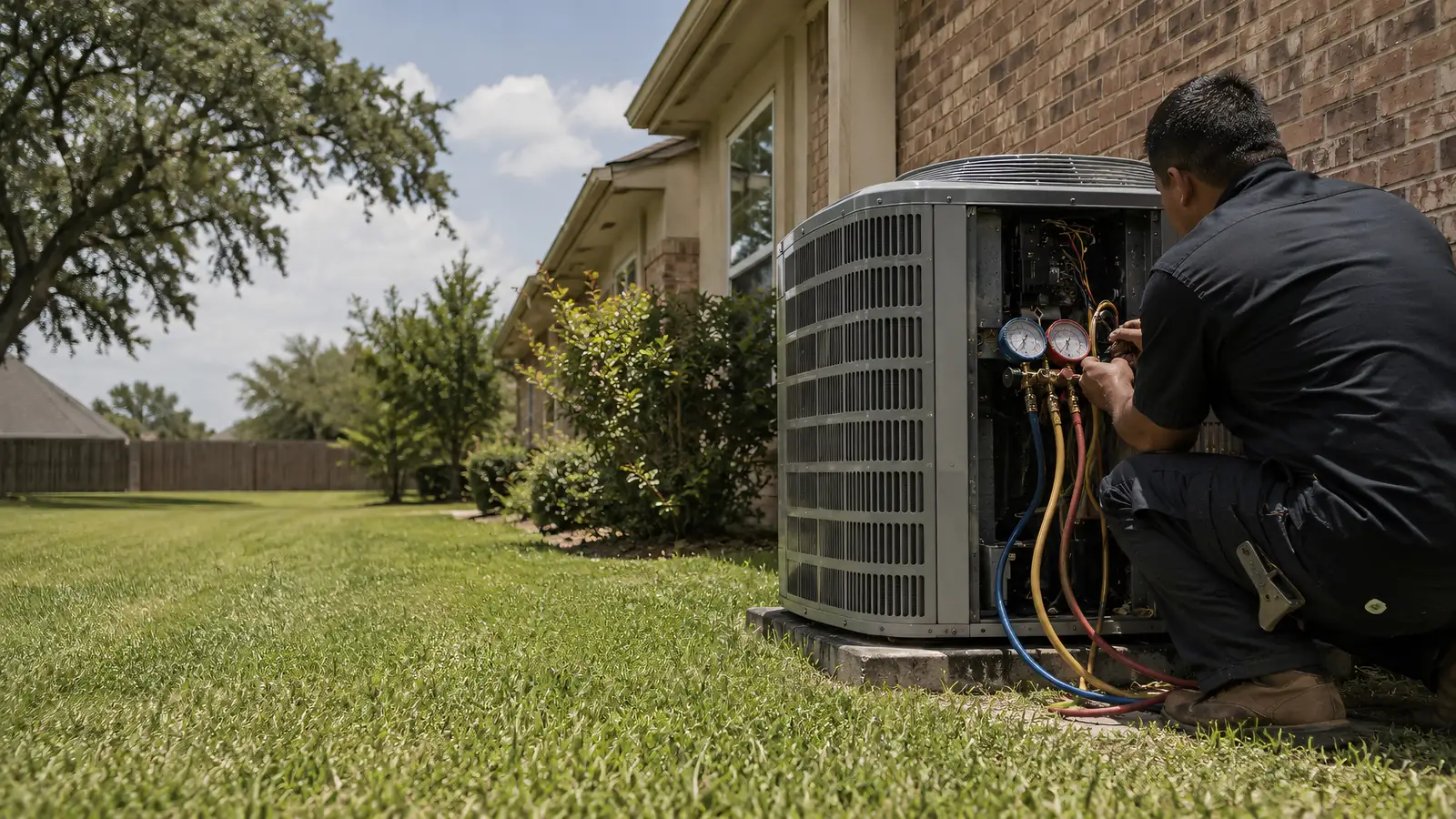
Stafford, Texas
AC repair and replacement for Stafford, Sugar Land and southwest Houston
Air conditioning is what this company does most. Repairs, replacements, ductwork and the airflow problems that make one room hot while the rest of the house is fine. 24/7 emergency HVAC service for breakdowns.
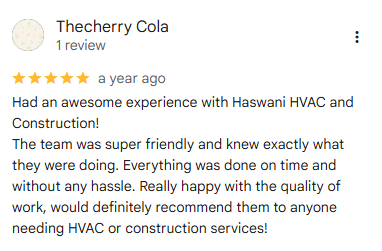
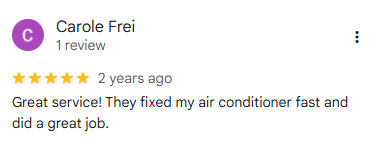
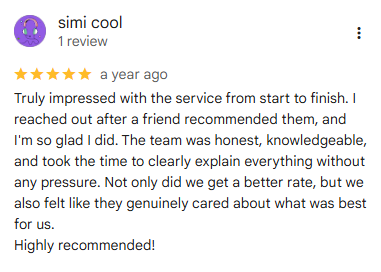
Reviews
What customers say
Five stars on Google and on Yelp, from homeowners across Houston and Fort Bend County.


What we do most
HVAC services
Roughly four out of five jobs are cooling work. These are the ones homeowners call about.
AC repair
Diagnosis and repair when a system stops cooling, runs constantly, trips a breaker or makes a noise it did not make last week.
AC replacement
Sizing, equipment selection and installation when repairing the old system stops making financial sense.
Emergency AC repair
Round-the-clock service for a house that has lost cooling in a Houston summer.
HVAC maintenance
Coil cleaning, drain line service, electrical checks and refrigerant readings before the season loads the system up.
Ductwork
Leak repair, sealing, resizing and rerouting. Often the reason a properly sized system still cannot keep up.
Zoning and airflow
Fixing the house where the thermostat is satisfied downstairs and nobody upstairs can sleep.
Indoor air quality
Filtration, humidity and ventilation in a climate that averages around 75% relative humidity.
Mini-splits
Ductless systems for garage conversions, additions, sunrooms and rooms the main system was never sized to cover.
Heating and furnace
Gas furnaces and heat pumps for the handful of weeks a year Houston actually needs them, plus the freeze events that catch people out.
In more detail
What kinds of HVAC work do we take on?
Six categories cover almost everything that gets booked. The figure under each one is why that category matters more in this climate than it would somewhere drier.
Repairs and emergency call-outs
The largest share of the work by volume. A system that has stopped cooling, one that runs without ever satisfying the thermostat, a breaker that trips every afternoon, a noise that was not there last week. Most of these come down to a failed electrical component, a restriction in airflow or a refrigerant charge that is no longer correct. The point of the visit is to find which, with readings, before anything gets replaced. AC repair and emergency service.
94°F average July and August highs in Houston, which is why a cooling failure here is not a problem that keeps until Monday.System replacement and installation
Sizing, equipment selection, permit, installation and commissioning. The part that gets skipped elsewhere is the load calculation: replacing like for like assumes the original tonnage was right, and it often was not. A replacement is also the one moment when a long-standing comfort problem can be corrected instead of inherited for another fifteen years. AC replacement.
14.3 SEER2 the federal minimum efficiency for new split-system air conditioners under 45,000 BTU/h in the South region, in force since January 2023.Ductwork, sealing and resizing
Leak repair, sealing, resizing and rerouting. This is the category most often mistaken for an equipment problem, because a correctly sized system delivering its air into an attic cannot cool a house no matter how new it is. Testing static pressure and airflow is what separates a duct problem from a charge problem. Ductwork.
up to 20% the heating and cooling efficiency improvement the US Department of Energy attributes to sealing and insulating ducts.Maintenance before the season loads the system
Coil cleaning, condensate drain service, electrical checks and refrigerant readings. The unglamorous version of this work is the drain line, because in a humid climate that is the failure that damages a ceiling rather than just a compressor. The valuable version is catching a slow refrigerant leak while it is still small. HVAC maintenance.
40% to 70% the reported rise in wholesale R-410A prices since 2022 as the HFC production cap tightens, which is what a slow leak on an older system now costs to keep topping up.Indoor air quality, filtration and humidity
Filtration, ventilation and humidity control. In a climate this humid the comfort complaint is frequently not temperature at all: a house held at 74°F that still feels clammy is a latent-load problem, usually caused by a system oversized enough that it never runs long enough to dehumidify. Indoor air quality.
2 to 5 times how much higher indoor concentrations of some pollutants can be than outdoor levels, according to the US Environmental Protection Agency.Heating, furnaces and heat pumps
Houston needs heat for a handful of weeks, which is exactly why heating faults go unnoticed until a freeze event arrives and every contractor in the region is booked at once. Gas furnaces, heat pumps and the electrical work that goes with changing between them. Heating and furnace.
about 50% the reduction in electricity used for heating that the US Department of Energy attributes to a modern heat pump versus electric resistance heat.Start here
What is your air conditioner actually doing?
Pick the symptom. Each page explains what it usually means, what is safe to check yourself, and what needs a technician.
The six that come up most
What kinds of AC problems do we fix?
Almost every cooling call lands in one of these six. Knowing which one you are looking at is most of the diagnosis.
Running, but the house keeps getting warmer
Air is moving at the vents and the system never shuts off, yet the temperature climbs through the afternoon. Three usual causes: airflow that has collapsed somewhere between the return and the supply, a refrigerant charge that is no longer correct, or a capacitor that has weakened enough to stop the compressor without stopping the fan. The order they are checked in matters, because two of them look identical at the thermostat. AC not cooling.
more than 30% of space-conditioning energy can be lost to ducts running through an unconditioned space such as an attic, according to the US Department of Energy.Nothing happens at all
Silence at the thermostat, or the indoor fan running with the outdoor unit dead. This is usually electrical: a tripped breaker, a failed contactor, a blown low-voltage fuse, or a float switch that has done its job and cut the system off because the drain pan filled. The float switch case is worth knowing about, because the system is not broken, it is protecting your ceiling. AC will not turn on.
around 102 days a year at or above 90°F in Houston, which is the runtime that contactors, capacitors and blower motors have to absorb here.Water where there should not be water
A ceiling stain, a damp patch near the air handler, or a drain pan standing full. In nearly every case it traces back to the condensate line rather than to a leak in the equipment. An evaporator coil pulls a serious volume of water out of the air every day in this climate, and all of it leaves the house through one narrow pipe that is usually in an attic. AC water leak and clogged drain lines.
around 75% average annual relative humidity in Houston, which is the water load that one condensate line has to carry away.Ice on the coil or the copper line
Counter-intuitive but common: a system that is freezing is a system that is not getting enough heat across its coil, either because airflow has dropped or because it is short of refrigerant. Turning it off and letting it thaw is the right first move; running it frozen risks sending liquid refrigerant back to the compressor, which is the expensive failure. Frozen AC coil.
5% to 15% the reduction in an air conditioner’s energy use the US Department of Energy attributes to replacing a clogged filter, which is also the most common starting point for a frozen coil.Refrigerant leaks
A system low on refrigerant did not use it up; refrigerant is not consumed. It leaked, and topping it up without finding the leak means paying for the same gas twice. What has changed is the economics: the refrigerant in most existing residential systems is now a phase-down product, which has made the top-up option considerably more expensive than it was. Refrigerant leak repair.
1 January 2025 the date manufacture and import of new R-410A residential split systems stopped under the EPA’s AIM Act. Servicing existing systems was not banned.One room, or one floor, that never keeps up
The thermostat is satisfied downstairs and nobody upstairs can sleep. This is almost never an equipment fault. It is a distribution problem: an undersized return, a long attic duct run, a room over a garage, or an addition the original system was never sized to cover. Fixing it means changing the air path rather than buying a bigger condenser. Upstairs not cooling and hot and cold spots.
April to October the stretch NOAA climate normals describe as Houston’s cooling season, which is seven months for a distribution fault to stay unresolved.The decision most people are actually facing
Repair it, or replace it?
Nobody wants to be talked into a new system, and nobody wants to spend money twice. The useful version of this conversation involves three numbers and one judgement call.
The numbers are the age of the equipment, the cost of the specific repair in front of you, and what you have already spent on the same system in the last couple of years. The judgement call is whether the failure is a wear part or a structural one. A capacitor is a wear part. A compressor or a leaking evaporator coil, on a system already past ten years, usually is not.
There is one more thing worth knowing before you get quoted. New residential systems no longer ship with R-410A refrigerant. Manufacturers stopped producing R-410A split systems for the residential market at the start of 2025 under the EPA’s AIM Act phase-down, and new equipment uses lower-GWP refrigerants such as R-454B or R-32. Practically speaking, that has pushed new system pricing up and has made R-410A itself more expensive to buy for topping up an old leaking system. It is a real factor in the repair-versus-replace maths now, and a company that does not mention it is not giving you the full picture.
Get a range before you call
The cost calculator gives Houston-area ranges for common repairs and for a full system replacement. No name, no email, no phone number. The estimate appears as you change the options.
Ranges are built from published Houston-area and national pricing data. The methodology and sources are shown on the page.
What makes this company different
Comfort problems are often building problems
Plenty of HVAC companies can replace a condenser. Fewer can tell you that the reason your upstairs never cools is a return air opening that was undersized when the house was framed, and then actually go and fix it.
Haswani runs HVAC alongside construction, electrical and plumbing work. When a diagnosis lands on something structural, a duct run that has to move, a chase that needs opening, a plenum that has to be rebuilt, a circuit that will not carry the new equipment, it stays with the same company instead of turning into three phone calls and a month of waiting.
That capability matters most on room additions, garage conversions, whole-home remodels and any job where the cooling system has to change shape instead of being swapped out where it stands.
Where the two sides overlap
- Adding a room and the existing system cannot carry it
- Converting a garage that has no ductwork at all
- Moving duct runs so a ceiling can be raised or a wall removed
- Rebuilding return air paths that were never big enough
- Upgrading the circuit and disconnect for new equipment
- Relocating an attic air handler that has flooded a ceiling once already
Why people call us
Why homeowners in Stafford and Sugar Land call us
Three things that are checkable rather than assertable. Each one is either a number you can verify or something the company can actually do.
The reviews are screenshots, not retyped quotes
All 12 reviews on this site are shown as screenshots of the live Google and Yelp profiles, ten on Google and two on Yelp. A quote retyped into a web page is indistinguishable from one a marketer invented; a screenshot carries the platform’s own chrome, the reviewer’s name and the date. No average rating is claimed anywhere, because 12 screenshots prove these reviews exist without proving they are the complete set.
A duct that has to move does not become somebody else’s job
Haswani runs HVAC alongside construction, electrical and plumbing. A large share of comfort complaints are building problems rather than equipment failures: a return opening undersized when the house was framed, a duct run that has to be rerouted, a circuit that will not carry the new equipment. Most HVAC companies stop where the building begins and hand that off. Here it stays with the same company.
Somebody answers at two in the morning
Emergency HVAC service runs around the clock. Cooling failures are not spread evenly across the year: they cluster on the hottest afternoons, in a city averaging 102 days at or above 90°F. Office hours are monday - saturday, 9:00am - 6:00pm, and the emergency line is not bound by them. The office is on Murphy Road in Stafford, which puts the core service area within about fifteen minutes.
Not sure whether it needs a technician today?
Describe the symptom on the phone. A lot of cooling problems narrow down to one or two likely causes before anyone drives out, and you will be told honestly whether it is urgent, whether it can wait, or whether it is something you can check yourself in five minutes.
Where we work
Service areas
The office is on Murphy Road in Stafford, which sits between Sugar Land, Missouri City and the Southwest Freeway. Most of the work happens inside a short radius of it, and coverage reaches out from there across Fort Bend County and into southwest Houston.
Stafford
The home market. Mixed housing ages, a large commercial corridor, and the office is minutes from most of the city.
Sugar Land
First Colony, Sugar Creek, New Territory, Greatwood, Telfair and Riverstone. Mostly two-storey homes with attic air handlers.
Missouri City
Quail Valley through Sienna. A wide spread of build dates, from late-sixties construction to current builds.
Southwest Houston
Sharpstown, Westbury, Meyerland, Braeswood and Fondren. Mid-century homes where the duct system is often the real problem.
Local conditions
Why equipment here works harder than the brochure assumes
Houston sits in a humid subtropical climate and averages about 102 days a year at or above 90°F, with July and August highs around 94°F and relative humidity averaging near 75%. Cooling season effectively runs April through October.
Two consequences show up constantly in service calls. The first is runtime. A system here accumulates far more operating hours per year than the same equipment installed further north, so wear parts such as capacitors, contactors and blower motors reach the end of their lives sooner. The second is condensate. A humid climate means an evaporator coil pulls a large volume of water out of the air every day, and all of it has to leave the house through a drain line that is usually in an attic. When that line clogs, the water finds a ceiling.
Neither of these is a reason to panic. Both are reasons that maintenance and drain line service earn their keep here in a way they might not in a dry climate.
Common questions
How quickly can somebody come out for a broken AC?
Do you charge to diagnose the problem?
Is my AC worth repairing or should I replace it?
Which areas do you cover?
Do you work on anything besides air conditioning?
Still not sure what you are dealing with? A technician can tell you in one visit.
Call (855) 758-5353Tell us what the system is doing
Describe the symptom and you will get a straight answer about whether it needs a technician today, tomorrow, or at all. 24/7 emergency HVAC service for breakdowns.