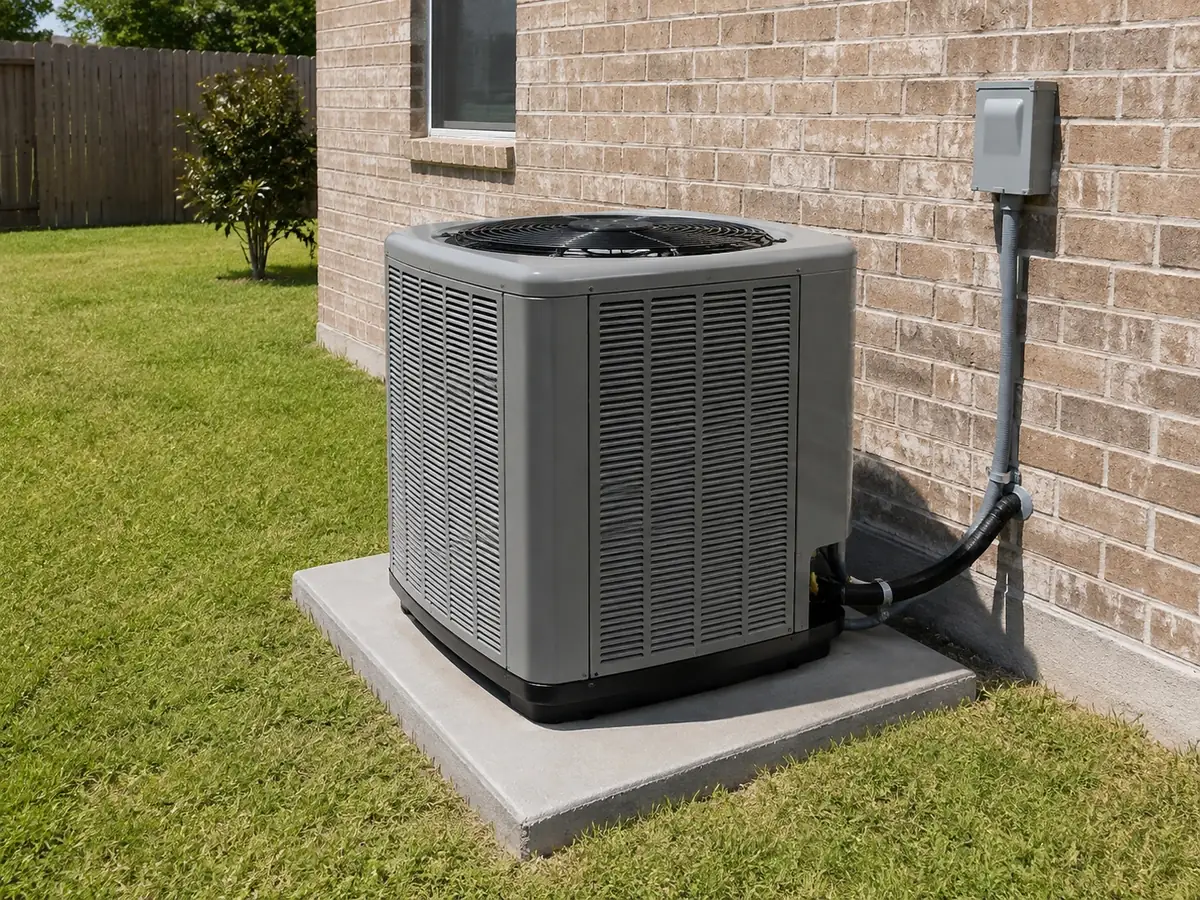
Replacement and installation
AC replacement and installation
Replacing a system is the largest single expense most homeowners face on a house that is not visibly broken. It is worth understanding what you are buying before anyone quotes you.
The honest version
What actually determines the price
Two quotes for “a new three ton system” can differ by several thousand dollars and both can be legitimate. The difference is usually in four places, and a quote that does not make them explicit is difficult to compare against anything.
Equipment tier
Single-stage builder-grade equipment at the efficiency minimum sits at one end. Two-stage and variable-speed inverter systems, which hold temperature and remove humidity more evenly, sit at the other. The gap between them is the single biggest line in most quotes.
Capacity and configuration
System size in tons, whether it is a straight cool with a gas furnace or a heat pump, and whether the indoor unit is a horizontal attic air handler or an upflow in a closet. Attic work costs more because everything is harder up there.
What else has to be done
New plenums, a corrected drain assembly, a float switch, a new pad, an electrical whip and disconnect, or a duct transition that was wrong the first time. This is where cheap quotes usually get cheap.
Refrigerant and permits
New residential systems now use lower-GWP refrigerants such as R-454B or R-32 rather than R-410A, which has pushed equipment costs up. The mechanical permit and inspection are a real, and modest, line item.
Published Houston-area pricing gives a sense of the range. One local company lists flat-rate system replacements from around $9,999 for a two ton to roughly $12,699 for a five ton, while national cost data for a full HVAC replacement in Houston clusters in the $7,500 to $14,000 region depending on scope and equipment. High-efficiency variable-speed systems run higher again. The cost calculator works from those published sources and shows its methodology.
The refrigerant change
Why 2025 changed the maths on old systems
Under the EPA’s AIM Act phase-down of high global warming potential refrigerants, manufacturers stopped producing residential split systems using R-410A at the start of 2025. New equipment uses lower-GWP alternatives, mainly R-454B in ducted systems and R-32 in a lot of ductless equipment. Systems already manufactured before that date can still be installed until existing stock runs out.
Two things follow from this if you own an older system.
First, new equipment costs more than the equivalent did a few years ago, partly because of the refrigerant itself and partly because A2L refrigerants require additional safety components in the equipment.
Second, and more immediately relevant, R-410A has become considerably more expensive to buy as the supply cap tightens. If your existing system has a leak and needs recharging, that repair costs more every year, and it will keep costing more. That does not automatically mean replace it. It does mean a recurring leak on an older R-410A system is a weaker investment than it was in 2021.
Questions worth asking any installer
- Is this quote based on a load calculation or on matching what is there now?
- Is the indoor coil being replaced with a matched unit?
- Are new plenums, drain assembly and float switch included?
- Who pulls the mechanical permit and schedules the inspection?
- What refrigerant does this equipment use?
- What is covered by the manufacturer warranty, and what by the installer?
These apply to every company you talk to, this one included.
How a replacement runs
From the first conversation to the inspection
Look at the house, not just the equipment
Size, layout, storeys, window exposure, insulation, where the ducts run and how the returns are configured. A replacement is the one moment when a long-standing comfort problem can be corrected rather than inherited for another fifteen years.
Size the system properly
A load calculation rather than an assumption that the existing tonnage was right. Oversizing is common and produces short run times, poor humidity removal and a house that feels clammy at 74°F.
Choose equipment against how you actually live
Efficiency tier, staging and whether variable speed is worth it for you. Someone staying five years and someone staying twenty should not necessarily buy the same system.
Permit, install, inspect
The mechanical permit is pulled, the old equipment is removed, the new system is installed with the ancillary parts it needs, and the work is inspected by the city. Stafford, Sugar Land and Missouri City each run their own process.
Commission it and hand over the paperwork
Charge verified against manufacturer specification, airflow checked, drain tested, thermostat configured, warranty registered. Registration matters. Unregistered equipment often carries a shorter parts warranty.
Local considerations
What replacement looks like in Fort Bend County houses
Most two-storey houses in Sugar Land and Missouri City run their air handlers in the attic, with duct trunks distributing from there. That configuration has consequences at replacement time worth thinking about before the truck arrives.
- Attic equipment sits above finished ceilings. The drain assembly, secondary pan and float switch are not optional extras. They are the reason a future drain clog stays a service call instead of a ceiling repair.
- Attic temperatures are extreme in summer. Duct leakage that would be a minor inefficiency elsewhere is a significant loss here, because the air escaping is going into a space far hotter than outdoors. Replacement is the natural moment to test and seal.
- Two-storey houses rarely balance on one system. If upstairs has never cooled properly, putting an identical system back will not change that. This is the point to look at zoning, return air sizing or a dedicated second system.
- Older neighbourhoods have older duct. In parts of southwest Houston the ductwork predates the equipment by decades. New equipment attached to undersized or deteriorated duct will underperform its rating no matter what is on the label.
Texas cities in this area require a mechanical permit for a full system changeout, and the contractor pulls it, not the homeowner. Stafford, Sugar Land and Missouri City each run their own permitting and inspection process.
Where we work
Service areas
Replacement work is concentrated in these four markets, all within a short drive of the Stafford office.
Stafford
The home market. Mixed housing ages, a large commercial corridor, and the office is minutes from most of the city.
Sugar Land
First Colony, Sugar Creek, New Territory, Greatwood, Telfair and Riverstone. Mostly two-storey homes with attic air handlers.
Missouri City
Quail Valley through Sienna. A wide spread of build dates, from late-sixties construction to current builds.
Southwest Houston
Sharpstown, Westbury, Meyerland, Braeswood and Fondren. Mid-century homes where the duct system is often the real problem.
Related pages
AC repair
What the alternative looks like, and when repair is still the better spend.
Ductwork
New equipment on bad duct underperforms. Worth checking before, not after.
Zoning and airflow
The moment to fix a two-storey balance problem is at replacement.
Evaporator coil replacement
Often the failure that starts the replacement conversation.
Compressor replacement
The other one. Usually the more expensive of the two.
Cost calculator
Replacement ranges by size and equipment tier, with sources shown.
Replacement questions
How long does a system replacement take?
Do I need a permit to replace my air conditioner?
What SEER rating do I have to buy?
Should I replace the indoor unit at the same time?
What is a Manual J and why does it matter?
Thinking about replacing your system? A conversation about the house is more useful than a price over the phone.
Call (866) 427-9264Talk through the system and the house
Age, size, what it has cost you lately and what it does badly. That conversation is the difference between a quote and a sensible recommendation.